


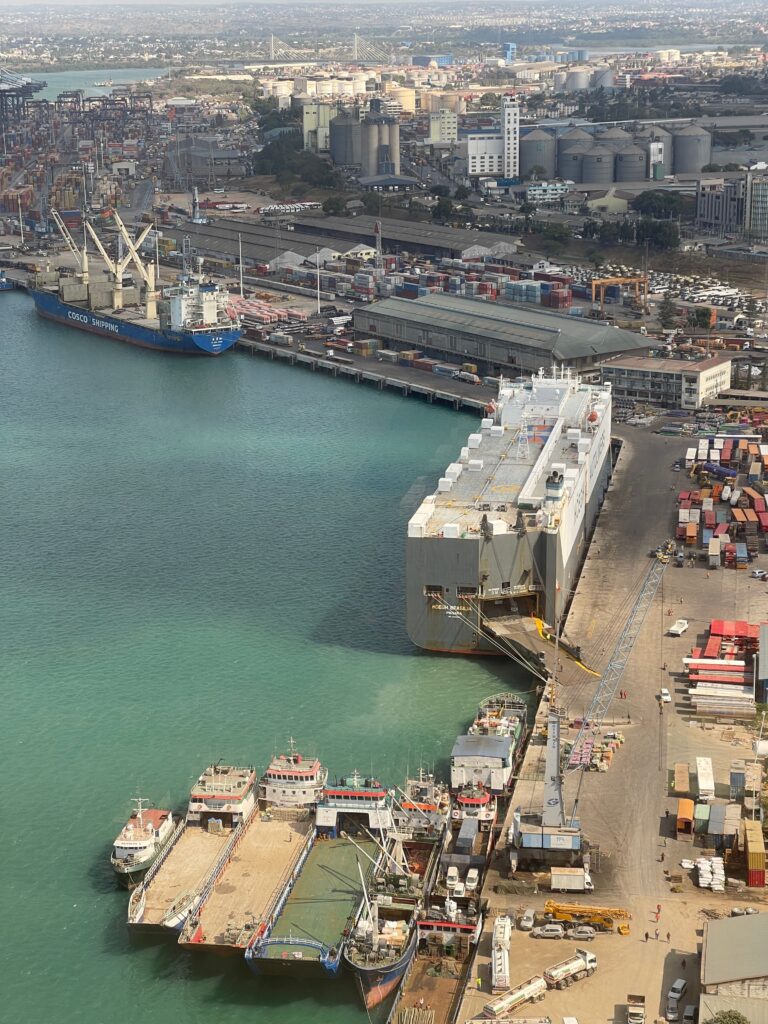
Somalia has a long maritime history shaped by its strategic position along the Gulf of Aden and the western Indian Ocean. For centuries, Somali coastal communities and merchants participated in maritime trade connecting the Horn of Africa with the Arabian Peninsula, India, and other parts of the Indian Ocean world.
Historic ports and coastal trading centres such as Zeila, Berbera, Mogadishu, Baraawe, and Kismayo played important roles in regional commerce. Somali merchants traded a wide range of commodities, including spices, textiles, ivory, livestock products, and other valuable goods. These ports were not isolated trading points; they were part of wider maritime networks that connected East Africa with Arabia, South Asia, and beyond.
Among Somalia’s historic ports, Mogadishu Port developed into one of the country’s most important maritime gateways. Its history reflects the broader transformation of Somalia’s coastal trade—from traditional Indian Ocean commerce to a modern port system handling containerized and bulk cargo.
Somalia’s Historic Maritime Trade
Somalia’s coastline has long provided access to important maritime routes in the Indian Ocean. Its location between the Arabian Peninsula and the East African coast made Somali ports valuable stopping points for merchants and ships travelling between different regions.
Mogadishu, Zeila, Berbera, Baraawe, and Kismayo developed as important coastal centres at different periods. Through these ports, goods moved between inland communities and overseas markets.
The maritime economy was supported not only by ports themselves but also by the people, ships, markets, warehouses, roads, and trading networks connected to them. In this sense, a historical port was much more than a place where ships arrived. It was a centre where maritime trade, coastal communities, and inland economies interacted.
Colonial Influence and the Transformation of Somali Ports
During the late nineteenth and early twentieth centuries, European colonial powers established control over different Somali-inhabited territories. Britain controlled British Somaliland in the north, while Italy established Italian Somaliland in much of the south. France controlled French Somaliland, centred on present-day Djibouti.
Colonial rule brought major changes to existing trade systems and coastal infrastructure. European administrations developed roads, railways, administrative centres, and port facilities to support their political and economic interests.
Mogadishu became particularly important under Italian administration. Infrastructure development during the twentieth century increasingly connected the port with inland areas, allowing goods to move between the coast and the interior.
This period therefore represented a major transition from traditional regional maritime trade toward a more centralized and infrastructure-dependent port economy.
Mogadishu Port: A Strategic Maritime Hub

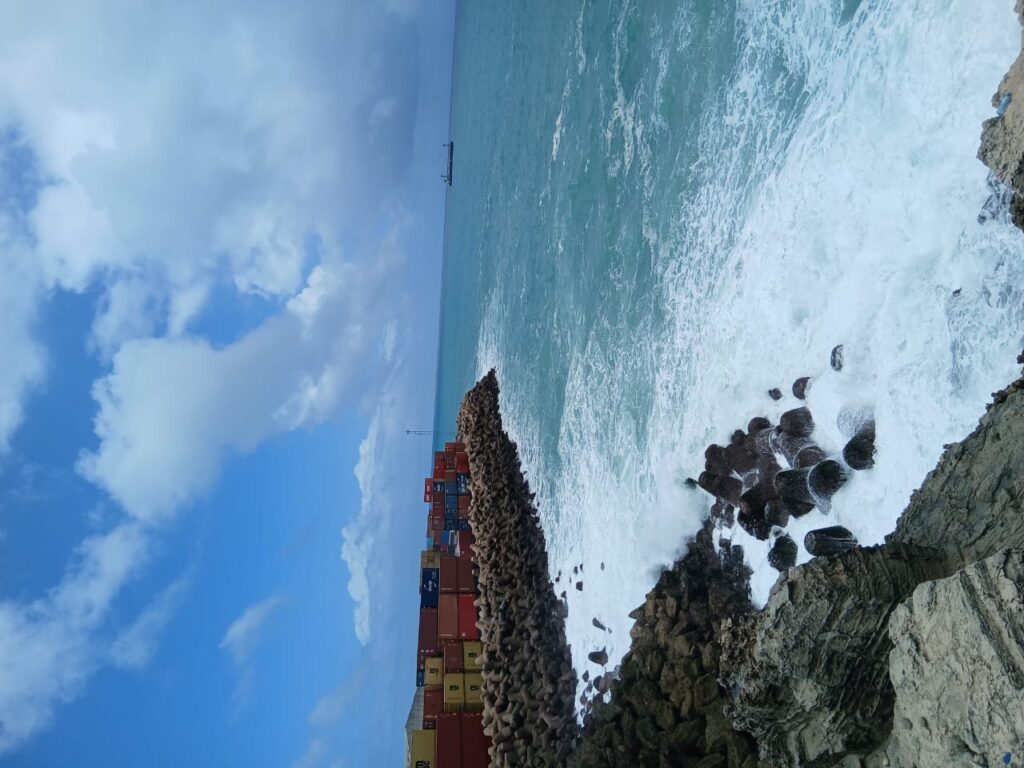
Mogadishu Port, also known as Mogadishu International Port, is located on Somalia’s southeastern coast in the capital city of Mogadishu. It is the country’s principal maritime gateway and one of its most important centers for international trade.
The port’s strategic importance comes partly from its location on the western Indian Ocean. Ships arriving at Mogadishu can connect Somalia with international maritime trade routes, while cargo moving through the port can be transported onward into the country’s inland markets.
The port is protected by major marine infrastructure, including an artificial breakwater, which helps reduce the energy of incoming waves and provides safer conditions within the harbour.
The Somali Ports Authority describes the port as having a navigation channel with a depth of approximately 14 metres. Current port information also describes Mogadishu as a multipurpose facility capable of handling several categories of cargo.
From Ancient Trade to Modern Commerce
Mogadishu’s maritime history extends far beyond the modern port infrastructure visible today.
The Somali Ports Authority describes ancient Mogadishu as Sarapion, a commercial centre mentioned in Roman-era records. The identification of ancient place names with modern locations can be complex, but the reference illustrates the long-standing importance attributed to Mogadishu within the western Indian Ocean trading world.
Over many centuries, Mogadishu developed as an important commercial centre on the East African coast. Its position allowed merchants to participate in trade across the Indian Ocean.
The modern transformation of Mogadishu Port accelerated during the colonial period. During the 1930s, major infrastructure works included protective dikes and breakwaters, together with transport connections such as railways and the road linking Mogadishu with Addis Ababa.
These developments changed the scale and organization of the port. Instead of serving primarily as a traditional coastal trading centre, Mogadishu increasingly functioned as a modern transport and logistics gateway connecting maritime traffic with inland areas.
Understanding the Port Infrastructur

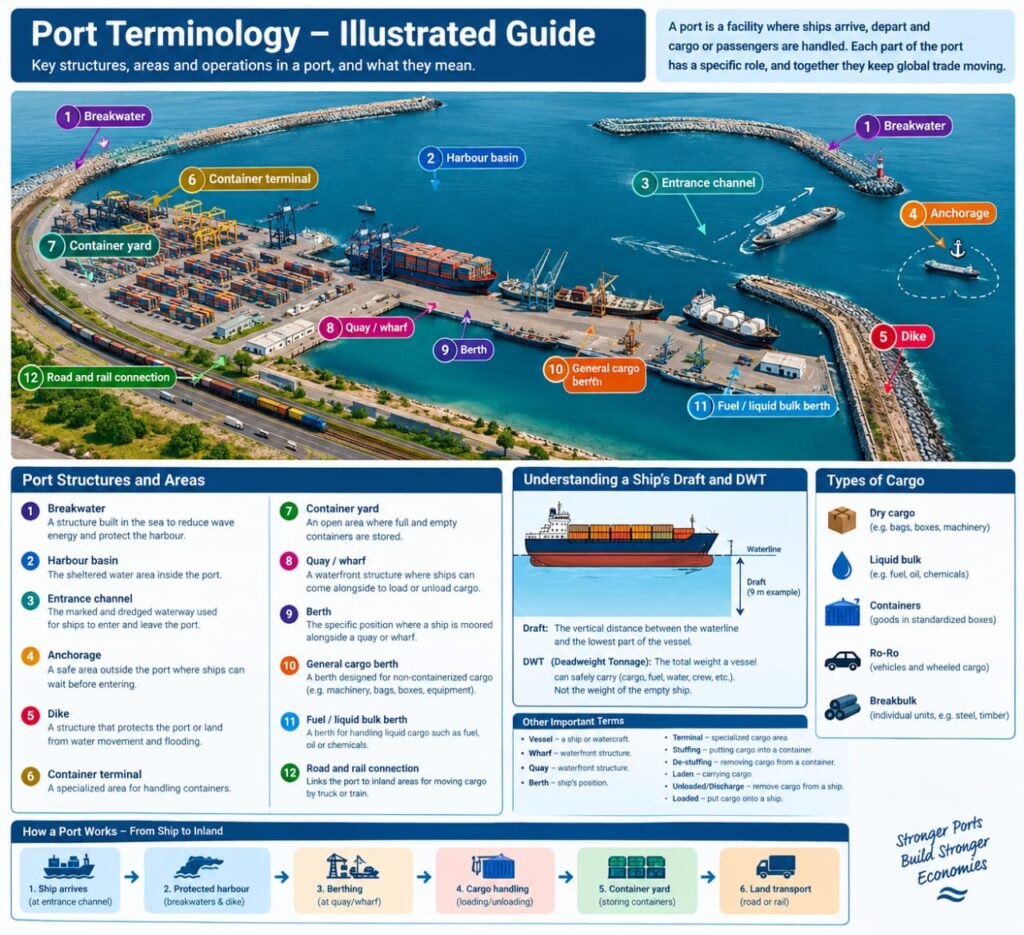
To understand how Mogadishu Port operates, it is useful to understand several important port terms.
Breakwater
A breakwater is a structure built in the sea to reduce the force of waves entering a harbour.
It protects ships, port infrastructure, and harbour waters from strong wave action.
A breakwater is different from a wharf. A breakwater mainly provides protection, while a wharf is a structure where vessels can come alongside to handle cargo or passengers.
Dike
A dike is a structure constructed to control or prevent the movement of water.
In port development, a protective dike can help protect land or infrastructure from waves, flooding, or water movement.
Wharf
A wharf is a structure along the waterfront where ships can come alongside to load or unload cargo.
The plural form is wharves.
For example, if we say that a port has six wharves, we are referring to six waterfront structures associated with vessel operations.
Berth
A berth is the designated position where a vessel is placed while it is in port.
A simple way to understand the difference is:
Wharf = the waterfront structure
Berth = the place where the ship is positioned
It is similar to the difference between a parking area and a specific parking space.
A port may therefore have a quay or wharf containing several berths.
Quay
A quay is a substantial structure along the edge of the water where vessels can berth and cargo can be handled.
The terms quay and wharf are sometimes used similarly in everyday port terminology, although their technical usage can vary.
When a port description gives a quay length, it is referring to the length of waterfront infrastructure available for vessel operations.
Mogadishu Port’s Modern Operations
Mogadishu Port is a multipurpose port, meaning that it handles different types of cargo rather than specializing in only one category.
Earlier descriptions of the port identified six wharves, including five general-cargo berths and a container berth. More recent port information describes a larger and developing quay and terminal infrastructure as modernization continues.
The port handles several categories of cargo, including:
- Containerized cargo
- General cargo
- Breakbulk cargo
- Dry bulk cargo
- Liquid bulk cargo
- Ro-Ro cargo
- Livestock and agricultural exports
This diversity makes the port important for Somalia’s import and export activities.
Container Terminal
A container terminal is a specialized part of a port designed to receive, handle, store, and transfer shipping containers.
Containers are standardized metal boxes used to transport cargo efficiently between ships, trucks, and other forms of transport.
A container normally follows a process such as:
Ship → Container terminal → Container yard → Truck → Inland destination
When an arriving ship reaches the container terminal, cranes and other handling equipment transfer containers between the vessel and the port.
Container Stuffing and De-stuffing
Two important terms in container logistics are stuffing and de-stuffing.
Container stuffing means placing cargo inside a shipping container.
Container de-stuffing means removing cargo from a container.
For example, imported goods may arrive inside a container. The container can be moved to an appropriate handling area, where the goods are removed and distributed to their destinations.
Container Yard
A container yard, often abbreviated as CY, is an area within or associated with a container terminal where containers are temporarily stored.
Containers may be:
- Full and waiting for transportation
- Empty and waiting for another shipment
- Waiting for customs or other procedures
- Being transferred between different stages of the logistics process
The container yard is therefore an important link between the ship and inland transportation.
What Types of Cargo Does Mogadishu Port Handle?
One of the most important characteristics of Mogadishu Port is its ability to handle different types of cargo.
General Cargo
General cargo refers to goods that are handled as individual units rather than as loose bulk material.
Examples may include machinery, packaged goods, equipment, and other individual cargo units.
Breakbulk Cargo
Breakbulk refers to cargo that is transported as individual pieces or units rather than being carried loose in bulk or inside standardized containers.
Examples can include bags, drums, large equipment, steel products, and other separately handled goods.
Dry Bulk
Dry bulk consists of large quantities of unpackaged solid material transported in bulk.
Examples include:
- Grain
- Cement
- Fertilizer
- Sand
- Minerals
Instead of placing every unit into a container, dry bulk cargo can be loaded or unloaded using specialized equipment.
Liquid Bulk
Liquid bulk refers to liquids transported in large quantities, commonly through tanks, pipelines, or specialized vessels.
Fuel and petroleum products are important examples of liquid bulk cargo.
Ro-Ro Cargo
Ro-Ro means Roll-on/Roll-off.
This system allows vehicles and wheeled machinery to drive directly onto and off a vessel using ramps.
Examples include:
- Cars
- Trucks
- Construction machinery
- Agricultural machinery
This is different from conventional cargo handling, where individual cargo units may need to be lifted using cranes.
Understanding Vessel Capacity: DWT and Draft
Port descriptions often contain technical terms that are important for understanding which vessels can use a port.
Deadweight Tonnage (DWT)
Deadweight tonnage, abbreviated DWT, is a measurement of how much weight a vessel can safely carry.
It does not simply mean the weight of the empty ship.
Deadweight includes the weight of cargo, fuel, freshwater, provisions, crew, and other loads carried by the vessel.
For example, a vessel with a deadweight capacity of 10,000 tonnes can carry a combined operational load up to approximately that amount, subject to its design and operating conditions.
Therefore, it is more accurate to say:
“A vessel has a deadweight tonnage of 10,000 tonnes.”
rather than saying:
“The vessel weighs 10,000 DWT.”
Draft
Draft, also spelled draught, is the vertical distance between the waterline and the lowest part of a vessel below the water.
Imagine looking at a ship from the side. The distance from the sea surface down to the deepest part of the hull is its draft.
This is extremely important for ports because a vessel with a deep draft requires sufficient water depth to enter and safely navigate the harbour.
For example:
Greater vessel draft → greater required water depth
This is why navigation channels and harbour basins are sometimes dredged to maintain sufficient depth for vessels.
Why Mogadishu Port Matters to Somalia
Mogadishu Port is more than a place where ships load and unload cargo. It is part of a wider logistics system connecting Somalia’s maritime economy with cities, businesses, consumers, and inland markets.
The port supports:
- International imports and exports
- Domestic distribution of goods
- Maritime transportation
- Employment
- Logistics and transportation services
- Government revenue
- Regional commercial connections
The Mogadishu Port Authority describes the port as Somalia’s main maritime gateway and a critical hub for international trade and commerce in the Horn of Africa.
The port is operated through a partnership involving the Somali government and Mogadishu Alport Corporation, associated with Turkey’s Albayrak Group. Albayrak states that it received the right to operate the port under an agreement with the Somali government in 2014.
Modernization has continued in recent years, including investment in port infrastructure and container-handling capacity.
Mogadishu Port and the Future of Somalia’s Maritime Economy
Somalia’s geographical position gives its ports an important role in the country’s future economic development.
The country has one of Africa’s longest coastlines and faces major maritime routes across the Gulf of Aden and Indian Ocean. Efficient ports can therefore provide an important connection between Somalia’s coastal areas, inland markets, neighbouring countries, and international shipping networks.
For Mogadishu Port, future development depends not only on physical infrastructure but also on efficient cargo handling, safe navigation, reliable transportation connections, modern port technology, skilled workers, and effective maritime governance.
As port infrastructure continues to develop, Mogadishu can strengthen its role as a maritime gateway while remaining connected to the much older Indian Ocean trading history of the Somali coast.
From a Historic Trading Port to a Modern Maritime Gateway
The history of Mogadishu Port reflects the broader maritime history of Somalia.
For centuries, Somali coastal communities participated in Indian Ocean trade, connecting East Africa with Arabia, India, and other regions. Later, colonial rule introduced new infrastructure and transformed traditional trading systems. During the twentieth century, Mogadishu Port developed into a more modern transport and logistics facility.
Today, the port handles containers, general cargo, bulk cargo, Ro-Ro shipments, and other forms of maritime trade. Its wharves, berths, quays, container yards, navigation channels, and cargo-handling facilities form a complex system that connects ships with Somalia’s economy.
From its historic role in Indian Ocean commerce to its modern function as an international maritime gateway, Mogadishu Port remains an important part of Somalia’s relationship with the sea.