
Introduction
Dugongs are marine mammals found in warm coastal waters extending from East Africa to Australia, including the Red Sea, the Indian Ocean, and parts of the Pacific Ocean. They are among the few fully marine herbivorous mammals and play an important ecological role in maintaining healthy seagrass ecosystems.
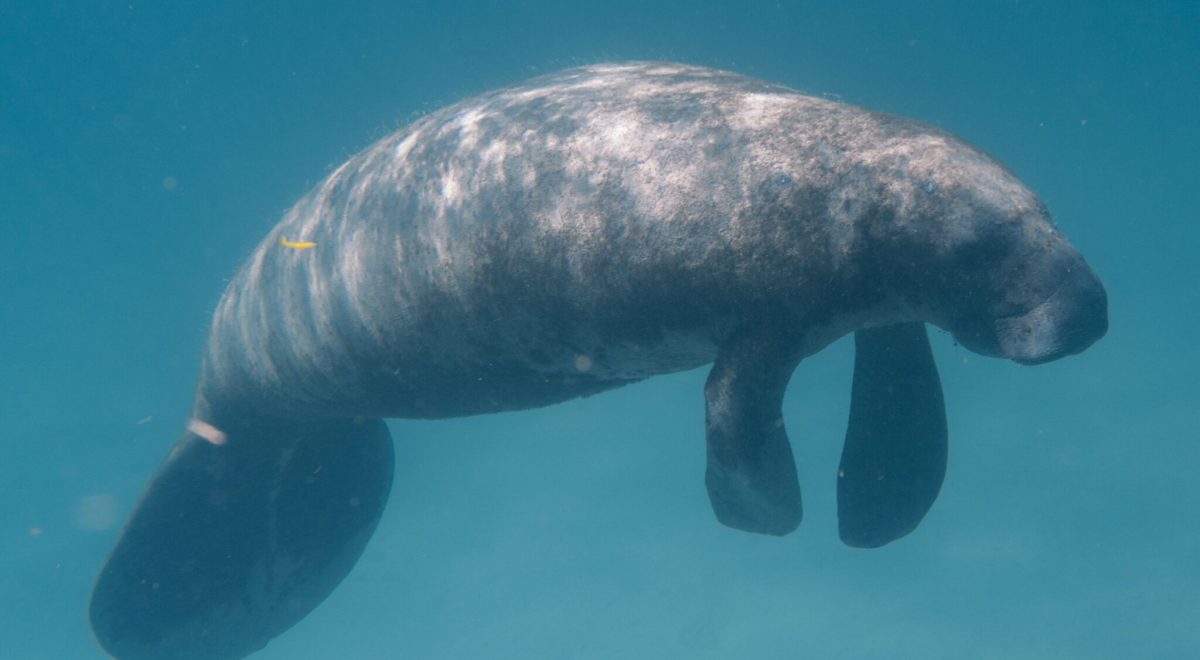
Dugongs are closely related to manatees and share a similar appearance and behavior. However, they can be distinguished by their whale-like fluked tail, whereas manatees possess a rounded paddle-shaped tail.
Although dugongs spend their entire lives in water, they are more closely related to elephants than to fish or whales. Both dugongs and elephants belong to a larger evolutionary group known as Afrotheria.
Scientific Classification
| Taxonomic Rank | Classification |
|---|---|
| Kingdom | Animalia |
| Phylum | Chordata |
| Class | Mammalia |
| Order | Sirenia |
| Family | Dugongidae |
| Genus | Dugong |
| Species | Dugong dugon |
Physical Characteristics
Dugongs have a streamlined body adapted for life in shallow coastal waters. Their skin is generally gray to brownish-gray, and they possess a broad snout specially adapted for feeding on seagrass.
Key Identification Features
| Feature | Description |
|---|---|
| Body Shape | Streamlined and spindle-shaped |
| Color | Gray to brownish-gray |
| Tail | Whale-like fluked tail |
| Diet | Exclusively herbivorous |
| Habitat | Shallow coastal waters and seagrass meadows |
| Breathing | Air-breathing marine mammal |
Distribution
Dugongs are distributed throughout the warm, shallow coastal waters of the Indian Ocean and western Pacific Ocean. Their range extends from the eastern coast of Africa to Australia and parts of Southeast Asia.
In East Africa, dugongs occur along the eastern coastline, with one of the largest remaining viable populations in the western Indian Ocean found in the Bazaruto Archipelago of Mozambique.
Global Distribution
- East Africa
- Red Sea
- Arabian Gulf
- Indian Ocean
- Southeast Asia
- Northern Australia
- Western Pacific region
Feeding Ecology
Dugongs are exclusively herbivorous marine mammals that depend entirely on seagrass for survival. They spend much of their time grazing on seagrass meadows located in shallow coastal waters.
An adult dugong can consume up to 50 kilograms of seagrass per day. Their feeding activities help maintain healthy seagrass ecosystems by promoting new growth and nutrient cycling.
Diet Summary
| Food Source | Importance |
|---|---|
| Seagrasses | Primary and essential food source |
| Marine Plants | Consumed occasionally in small amounts |
Because dugongs rely almost entirely on seagrass, they are strongly associated with healthy seagrass meadows.
Ecological Importance
Dugongs are often called the “gardeners of the sea” because their grazing helps maintain productive seagrass habitats.
Healthy seagrass meadows provide:
- Nursery grounds for fish and invertebrates.
- Food sources for marine organisms.
- Carbon storage and climate regulation.
- Sediment stabilization and coastal protection.
By feeding on seagrass, dugongs contribute to the overall health and productivity of coastal ecosystems.
Threats to Dugongs
The survival of dugongs is closely linked to the condition of seagrass habitats. As a result, dugong populations are highly vulnerable to environmental degradation.
Major threats include:
- Destruction of seagrass meadows.
- Coastal development.
- Pollution.
- Accidental capture in fishing gear.
- Boat strikes.
- Habitat degradation.
The loss of seagrass habitats can significantly reduce dugong populations because these animals depend entirely on seagrass for food.
Conservation Status
According to the International Union for Conservation of Nature (IUCN) Red List, the dugong is currently classified globally as:
Vulnerable (VU)
Dugongs occurring in Somali waters belong to the East African subpopulation. This regional population faces significant conservation challenges and is considered at a much greater risk than the global population.
Conservation Status Summary
| Population | Status |
|---|---|
| Global Population | Vulnerable |
| East African Subpopulation | Critically Endangered |
Dugongs in Somalia
Dugongs are part of Somalia’s valuable marine biodiversity and are associated primarily with coastal seagrass habitats. Somali waters provide suitable conditions for dugongs due to the presence of shallow coastal areas and seagrass meadows.
Because dugongs depend entirely on seagrass, the protection of Somalia’s seagrass ecosystems is essential for their long-term survival.
Conserving dugongs also benefits many other marine species that depend on healthy seagrass habitats.
Conclusion
Dugongs (Dugong dugon) are unique marine mammals that inhabit warm coastal waters from East Africa to Australia. These gentle herbivores depend entirely on seagrass meadows and play a vital role in maintaining healthy coastal ecosystems. Although globally classified as Vulnerable, East African populations face severe conservation challenges. Protecting Somalia’s seagrass habitats is therefore essential for safeguarding dugongs and preserving the country’s rich marine biodiversity for future generations.