
Introduction
The Yellowfin Tuna (Thunnus albacares), locally known in Somalia as Jeeydar, is one of the most important and commercially valuable tuna species found in Somali waters. It is a highly migratory pelagic fish that inhabits tropical and subtropical oceans around the world. Due to its fast growth, strong swimming ability, and economic importance, Yellowfin Tuna plays a significant role in both global fisheries and Somalia’s marine resources.
Scientific Classification
| Taxonomic Rank | Classification |
|---|---|
| Kingdom | Animalia |
| Phylum | Chordata |
| Class | Actinopterygii |
| Order | Scombriformes |
| Family | Scombridae |
| Genus | Thunnus |
| Species | Thunnus albacares |
Physical Characteristics
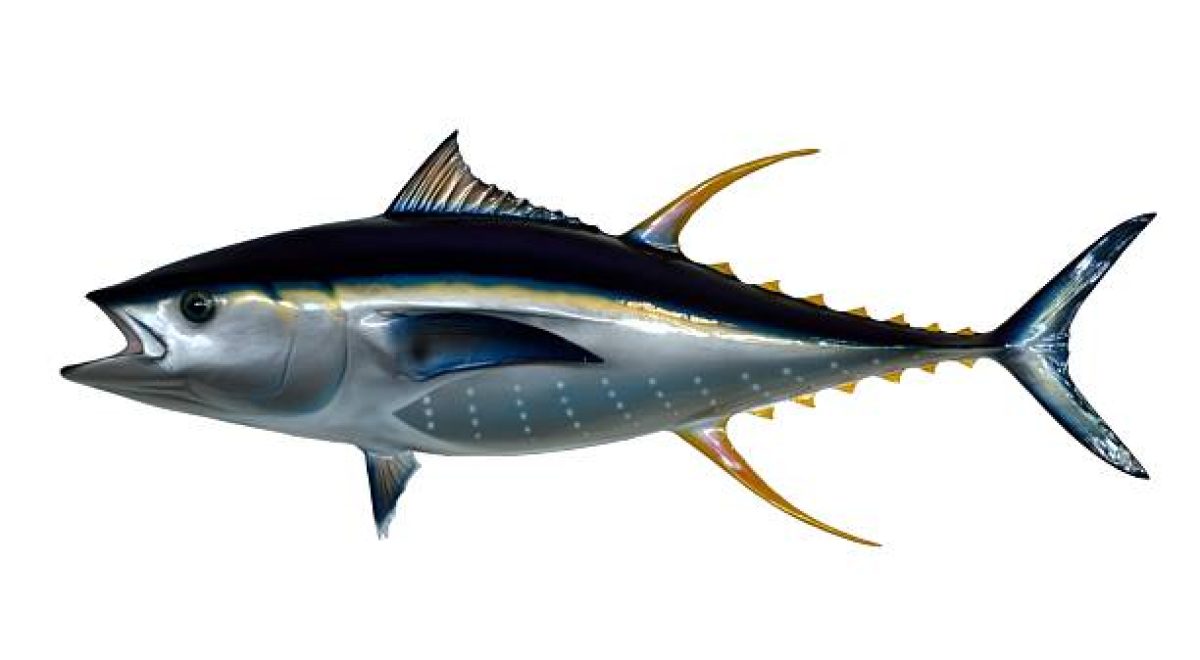
Yellowfin Tuna has a streamlined, torpedo-shaped body designed for fast swimming in the open ocean. The back and upper sides are metallic dark blue, while the belly is silvery white.
The species is easily recognized by its long, bright yellow second dorsal fin and anal fin. The finlets located behind these fins are also bright yellow with black edges. A yellow stripe often runs along the sides of the body.
Compared with the Bluefin Tuna, Yellowfin Tuna is generally more slender and streamlined.
Identification Features
| Feature | Description |
|---|---|
| Body Shape | Torpedo-shaped and streamlined |
| Color | Metallic dark blue back and silvery belly |
| Dorsal Fin | Long and bright yellow |
| Anal Fin | Bright yellow |
| Finlets | Yellow with black margins |
| Body Form | More slender than Bluefin Tuna |
Distribution and Habitat
Yellowfin Tuna is widely distributed throughout tropical and subtropical oceans. It is a pelagic species, meaning it spends most of its life in the open ocean rather than near the seabed or coastal habitats.
The species thrives in water temperatures ranging from 20°C to 30°C. Although Yellowfin Tuna commonly inhabits the upper 100 meters of the water column, it is capable of making deep dives reaching depths of approximately 1,000 meters.
Somalia’s productive offshore waters provide suitable habitat for this species, making it one of the most important tuna resources in the region.
Size and Lifespan
Yellowfin Tuna is among the larger tuna species.
| Characteristic | Information |
|---|---|
| Maximum Weight | Up to 400 pounds (approximately 180 kg) |
| Lifespan | About 7 years |
| Habitat Zone | Pelagic (open ocean) |
Reproduction
Yellowfin Tuna reaches sexual maturity relatively early. Some individuals can begin reproducing at approximately 2 to 3 years of age.
Spawning occurs in warm tropical waters where females release large numbers of eggs into the water column. Fertilized eggs hatch into larvae that develop rapidly under favorable conditions.
Behavior and Schooling
Young Yellowfin Tuna often travel in schools together with Skipjack Tuna (Katsuwonus pelamis) and juvenile Bigeye Tuna (Thunnus obesus).
Schooling behavior provides several advantages, including protection from predators and increased efficiency when locating food-rich areas. Adult Yellowfin Tuna may form large schools that move across vast oceanic regions.
Feeding Ecology
Yellowfin Tuna is an active daytime predator that feeds primarily during daylight hours.
Its diet consists mainly of:
- Fish
- Squid
- Crustaceans
These predators often form schools to locate areas with abundant prey. Research indicates that Yellowfin Tuna may consume approximately 1.95% of its body weight per day, depending on environmental conditions and food availability.
Diet Summary
| Prey Group | Examples |
|---|---|
| Fish | Small pelagic fishes |
| Cephalopods | Squid |
| Crustaceans | Shrimp and other crustaceans |
Economic Importance
Yellowfin Tuna is one of the world’s most valuable commercial fish species. It supports major fisheries across the Atlantic, Pacific, and Indian Oceans and contributes millions of dollars annually to the global seafood industry.
The species is highly sought after for fresh, frozen, and canned tuna products. In Somalia, Yellowfin Tuna represents an important fisheries resource with significant economic potential for coastal communities and national development.
Conservation Status
According to the International Union for Conservation of Nature (IUCN) Red List, Yellowfin Tuna is currently classified as:
Least Concern (LC)
Although the species remains widespread and abundant, sustainable fisheries management is essential to ensure healthy populations for future generations.
Conclusion
Yellowfin Tuna (Thunnus albacares), locally known as Jeeydar, is one of Somalia’s most important pelagic fish species. Its remarkable swimming ability, migratory behavior, economic value, and ecological role make it a key component of marine ecosystems and global fisheries. Protecting and sustainably managing this valuable resource is essential for maintaining healthy tuna populations and supporting the livelihoods that depend upon them.